
Climate and sustainable development financing, multilateral institution reforms, regulation of digital assets, the spillover effect on developing economies from actions of western central banks, energy and food security in the backdrop of war in Europe, and sanctions on Russia and their impact on the global economy are some of the agenda items that India will take up as President of G-20, Finance Minister Nirmala Sitharaman said on Tuesday. India will take over as President of the powerful international grouping on December 1 for a year. There will be around 200 meetings throughout the country, with the summit Heads of State meeting expected to be held in New Delhi next September.
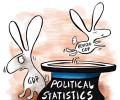
The Economic Survey 2022-23 (FY23), to be presented a day before Union Budget 2023-24 (FY24), is likely to project India's real gross domestic product (GDP) growth between 6 per cent and 7 per cent for FY24, Business Standard has learnt. The broader theme of the Survey could be on how India has dealt with two years of a global pandemic and the ongoing geopolitical disturbance, the strengths and weaknesses that emerged, and what lessons may be learnt. The much-awaited Survey will be the first one by Chief Economic Advisor V Anantha Nageswaran and his team in the finance ministry's economic division.

'If you look at the order books of capital equipment companies or money deployed on the ground, there is forward movement in terms of actual investment by the private sector.'

The Centre is in "mission mode" to fill vacancies in government departments and ministries. The Department of Expenditure is currently following up with other wings of the government to expedite pending appointments. Regular follow-ups are being made to fill the vacant positions, so that the stated target of eliminating 1 million vacancies is met by December 2023, ahead of the next Lok Sabha elections. Even as the nodal ministry for filling vacant positions in the government is the Department of Personnel and Training (DoPT), the Department of Expenditure's Establishment Coordination (Personnel) division is providing support for the recruitment drive.

The Serious Fraud Investigation Office (SFIO) has arrested a person who the Ministry of Corporate Affairs (MCA) said has emerged as the mastermind of the racket of incorporating a large number of shell companies with Chinese links in India.

Days after Moody's cut its gross domestic product (GDP) forecast for financial year 2022-23 (FY23) after the official GDP print for the June quarter came in lower than expectations, the global ratings agency said it would maintain its long-term sovereign debt credit rating and outlook on Asia's third-largest economy. "The credit profile of India reflects key strengths, including its large and diversified economy with high growth potential, a relatively strong external position, and a stable domestic financing base for government debt," Moody's said on Tuesday. "We do not expect rising challenges to the global economy, including the impact of the Russia-Ukraine military conflict, higher inflation, and the tightening financial conditions on the back of policy tightening, to derail India's ongoing recovery from the pandemic in 2022 and 2023," it said.

If that happens, India's economic size will be just shy of $20 trillion and its annual per capita income will be about $10,000, when the country celebrates its centenary of independence.
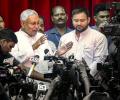
Various indicators make it amply clear that there are grave challenges facing the new government of Chief Minister Nitish Kumar, reports Indivjal Dhasmana.

The Centre has garnered around Rs 2,500-3,000 crore in the first five weeks after it imposed a windfall tax on oil and gas companies for the export of fuel, Business Standard has learnt. It is likely that the government will continue with the one-time tax till the Indian crude basket is above $80 a barrel, sources said. The next review of the windfall tax on oil companies is early next week.
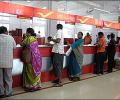
The staff at post offices misappropriated Rs 95.62 crore of public money between November 2002 and September 2021, the Comptroller and Auditor General has said. The money may seem small but it is what common citizen invested in post office savings, the oldest and the largest banking system in the country. The system serves the investment needs of urban and rural clients through schemes such as savings bank, recurring deposits, time deposits, national savings certificates, kisan vikas patras, public provident fund, monthly income account scheme, sukanya samriddhi accounts and senior citizens savings scheme.

Income-tax payers fear they will receive notices from the government because the annual information statement (AIS) provided by the I-T department in many cases is showing incomes in excess of their earnings. The Central Board of Direct Taxes (CBDT) has dismissed these fears as unfounded. The deadline for filing income-tax returns (ITRs) for the assessment year 2022-23 ended on July 31.

The Centre's capital expenditure (capex) outlay for the April-June quarter (first quarter, or Q1) of 2022-23 (FY23) could be close to Rs 1.5 trillion, Business Standard has learnt. As a percentage of full-year capex Budget Estimates (BE) of Rs 7.5 trillion, this could be at similar levels to the trends in the past few fiscal years. It is in the July-September quarter (Q2) of FY23 that capex is expected to pick up, when a bulk of the long-term capex loans to states are expected to be expended.

The impact of fiscal measures announced by the government to contain inflation will be seen in the next few months because of the base effect, reports Indivjal Dhasmana.

'It is building the country's infrastructure, and delivering it very efficiently.'

Moody's Investors Service has warned that India, along with the Philippines, Thailand, and Vietnam are highly vulnerable to volatile food and energy prices in the Asia-Pacific region as the Russia-Ukraine conflict continues to disrupt supplies and raise the cost of agricultural products, especially cereals and vegetable oils, as well as fertilizers and other agricultural inputs. This is so because these countries have a higher weighting of energy and food prices in their consumer price index (CPI) baskets, Moody's said in its report released on Tuesday. The weighting of energy and food in overall Indian CPI stands at over 55 per cent.

During his first Union Budget in July 2014, former finance minister Arun Jaitley announced the setting up of an institution called 3P India, with an allocation of Rs 500 crore. The intention was to mainstream public-private partnerships (PPPs) in India. The plan was to bring together the capacities of the government and private sector to push PPP projects.

The Union government will take a bit longer to introduce the much-awaited labour codes even as the majority of states and Union Territories (UTs) have framed rules on them. There were speculations that these would be introduced from July 1. While 30 states and UTs have framed rules on the code on wages, 25 of them have done so on industrial relations. Of the two remaining codes, 24 states and UTs have framed rules on social security and 23 on occupational safety, health, and working conditions (OSH), sources said.
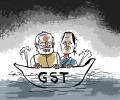
Agra has long been known for the Taj Mahal, but it is also a manufacturing hub filled with micro, small and medium enterprises (MSMEs) that make everything from electronic components to metal products, from paints and chemicals to footwear. And five years after the introduction of the Goods and Services Tax (GST), the MSMEs here complain that while the indirect tax regime has been transformative, cutting out the need to file multiple taxes, its biggest drawback has been the delay in credit refunds. Whoever you speak to - MSME owners, tax lawyers, or industry bodies like the National Chambers of Industries and Commerce (NCIC), Agra Footwear Manufacturers and Exporters Chamber (AFMEC) and Agra Shoe Manufacturers Association (ASMA) - they all emphasise that the GST continues to face some key challenges.

The government expects indirect tax collection to be lower than the Budget Estimate (BE) of Rs 13.38 trillion this fiscal year, despite prospects of netting goods and services tax (GST) in large amounts, Revenue Secretary Tarun Bajaj has said. "Indirect tax collection may see lower realisation than budgeted on account of cuts in excise and customs duties. "We could see a shortfall of about Rs 1.5 trillion on account of those," he told Business Standard.

Union finance secretary T V Somanathan recently said the Centre had saved Rs 10,000 crore in FY22 on interest payments after adopting new accounting mechanisms for central government agencies and centrally sponsored schemes (CSS) for state governments. Speaking at an event, Somanathan said due to these, there was an unspent balance of Rs 1.2 trillion with state agencies from CSS as on March 31, 2022. This means this amount will be reduced from the Centre's borrowing for now and it can be considered a short-term saving for the exchequer.
 © 2026 Rediff.com - Advertise with us - Disclaimer - Privacy Policy - Sitemap - Feedback - About us - Terms of use - Grievances